
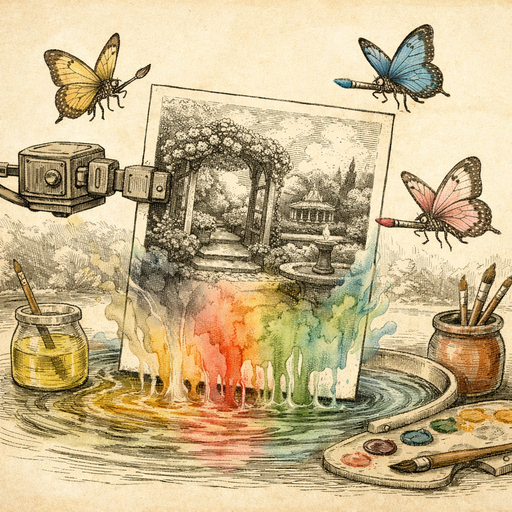
The Millbrook Gazette has been publishing since 1887. Somewhere in a dusty filing cabinet at the county library, there are 137 years of photographs: the original town square, the 1923 flood that swept away half of Main Street, the winning team from the 1951 Little League championship, and three generations of July Fourth parades. Every single one of those photos is grey. Not moody, artistic grey. Just grey. The kind of grey that makes your brain quietly file the images under "old stuff" and move on without really connecting to the people in them.
Here is the strange psychology of it: when we see black-and-white photos, we subconsciously process them as History with a capital H. Important, certainly, but distant. Belonging to someone else's era. The moment color appears, something clicks. Those aren't historical figures anymore. That's a woman in a teal apron standing outside a brick storefront on a hot afternoon. That's a kid in a red-striped shirt squinting into the sun at a baseball game. They become people.
Why Local Archives Are Sitting on Untapped Gold
Every county in the country has some version of this problem. Historical societies, local libraries, small-town newspapers, and genealogical clubs are custodians of genuinely fascinating visual records, but the presentation is doing all that content a disservice. People donate photos, volunteers scan them, and then the images get uploaded to a website or framed for a display case, still grey, still distant, still quietly ignored by anyone under 50.
The engagement gap is real. A historical society in rural Ohio reported that their colorized photo posts on Facebook consistently get three to four times more shares than their original scans. Not because the colorized versions are more accurate (they aren't, necessarily), but because color creates immediate emotional connection. People tag their relatives. They comment with "that's my grandmother's street!" They actually stop scrolling.
This is the thing archivists have slowly figured out: colorization isn't replacing history. It's giving people a door into it.
What AI Colorization Actually Does
The short version: a neural network trained on millions of images has learned that grass is green, brick walls are usually reddish-brown, denim is blue, and skin tones follow predictable patterns across different lighting conditions. When you feed it a grey photo, it's essentially making a series of extremely educated guesses based on texture, context, and pattern recognition.
The results are genuinely impressive for organic subjects: people, foliage, wooden buildings, fabric, skin. The AI excels because these things appear in patterns it has processed thousands of times. It's less confident with unusual or ambiguous objects, which is why a red vintage car might occasionally end up blue. The AI didn't see the car's original color, only its shape and context. (If only the AI could have been there in 1953 to take notes.)
For local history work, this means the process shines on portrait photos, street scenes, and outdoor community events. The faces, the storefronts, the foliage in the background, the clothing, all of this is territory where AI colorization produces results that feel remarkably real.
A Practical Workflow for Community Projects
If you're working with a historical society, a library archive, a community newsletter, or just your own family's collection, here's a workflow that actually produces good results without requiring any specialized software or uploads to a third-party server.
- Start with the best scan you have. AI colorization works with what it gets. A sharp, well-contrasted scan will produce dramatically better color output than a dim, low-resolution one. If the original photo is faded or soft, consider running it through AI Enhance first to boost contrast and clarity before colorizing.
- Colorize directly in your browser. Upload the image to COMBb2's AI Colorizer, which processes everything locally. The photo never leaves your device, which matters when you're working with photos that may have privacy implications or institutional ownership restrictions. You're not sending a 1943 family portrait to a server in an unknown jurisdiction.
- Review with skepticism. Check the output against any contextual clues you have. If the photo caption mentions a green car, and the AI rendered it brown, that's worth noting. Colorization is an interpretation, not a fact. Label your output accordingly: "AI-colorized interpretation" is accurate and transparent.
- Consider denoising before colorizing. Older scans often have grain from the original film or from scanning noise. Running the image through AI Denoise before colorization gives the AI cleaner texture data to work from, which often produces more accurate color decisions in fabric and shadow areas.
- Save both versions. Always keep the original greyscale file alongside the colorized one. The grey version is the historical record. The color version is the engagement tool.
The Community Project That Actually Works
Here's a format that small community organizations have found genuinely effective for engagement: "Then and Now" social posts pairing a colorized historical photo with a modern photo of the same location. The colorized image makes the old photo feel present-tense, which makes the contrast with the modern photo far more striking.
A town square in 1931 with colorized shopfronts, cloth awnings in faded blues and greens, a horse-drawn cart in the foreground, set next to a 2024 photo of the same corner with a coffee chain and parking meters. The pair stops people cold. It creates a conversation. It makes history feel like something that happened to your street, not to some abstract elsewhere.
Libraries and historical societies that have adopted this format for their social media report that volunteers start coming forward with additional photos and information. Colorization, oddly, turns out to be a community engagement strategy.
When to Be Honest About What You're Showing
This deserves its own section because it matters. AI colorization is an interpretation, not a restoration. The AI does not know what color Margaret Chen's dress was when she stood outside the pharmacy in 1934. It's making a statistically likely guess. That guess might be exactly right, or it might be a charming shade of mauve that Margaret would have found alarming.
Responsible community history work means being transparent. Label colorized images clearly. Include a note in any display or publication explaining that colors are AI-generated estimates, not verified historical records. This isn't a disclaimer that ruins the experience. If anything, it adds a layer of intrigue: this is what the AI thinks 1934 looked like. What do you know about the actual colors?
That question, asked honestly, invites the community to contribute. Older relatives remember. Oral histories contain color details. Catalogs and advertisements from the era show what fabrics and paint colors were commercially available. Colorization becomes a starting point for research rather than an endpoint.
Conclusion
Local history is consistently underfunded, underappreciated, and viewed by most residents as something for retirees with too much time on Saturdays. Colorization doesn't solve that problem entirely, but it chips away at the psychological distance between modern audiences and historical material in a way that captions and exhibit text simply cannot. Giving a grey photograph color is essentially translating it into a language that contemporary viewers process instinctively. The people in that 1951 Little League photo stop being "historical figures" and start being someone's grandfather in a dusty yellow cap. That shift, minor as it sounds, is the difference between an image that gets skimmed and one that gets remembered. Your town's history deserves at least that much of a fighting chance.
Try it yourself
Free, private, runs in your browser. No sign-up required.