
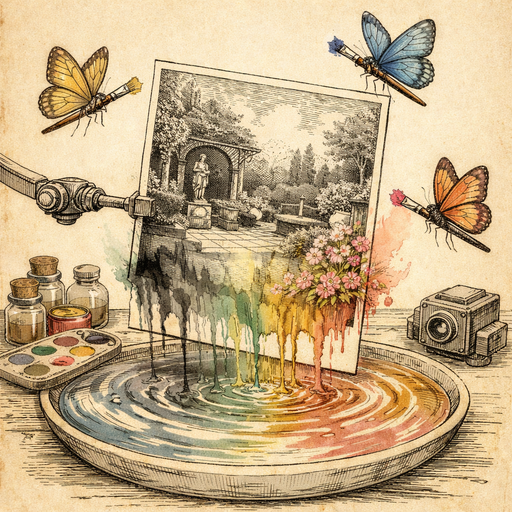
It started with a Reddit post. A fan of a minor league baseball team in Ohio dug up a 1923 championship photo from the local library's digital archive, posted it to the team's subreddit, and watched it get exactly eleven upvotes before disappearing into the void. The photo was muddy grey, the players looked like they were standing in a light fog, and frankly, you could have told anyone it was a photo of accountants at a company picnic and they would have believed you. Two weeks later, someone colorized it. That same photo got fourteen thousand upvotes, was picked up by three sports history newsletters, and ended up framed in the team's current stadium. Same photo. Different century, same pixels. Just color.
The Problem with Sports History Living in Greyscale
Here's an underappreciated tragedy: nearly a century of professional and amateur sports history exists in black and white. The 1927 Yankees, the original Harlem Globetrotters, the very first FIFA World Cup in Uruguay, your great-uncle's semi-pro hockey team from 1951. All of it looks like it happened on a different planet, populated by spectral figures who apparently never experienced a sunny afternoon.
This isn't just a visual problem. Psychologically, greyscale creates emotional distance. We know intellectually that Babe Ruth was a real person who wore an actual uniform with actual colors, but when every image of him looks like a daguerreotype, the brain quietly files him under "historical artifact" rather than "human being who was objectively enormous and ate hot dogs for breakfast." Color collapses that distance in an almost unsettling way.
Sports fan communities have started figuring this out. Facebook groups dedicated to vintage baseball, subreddits for defunct hockey franchises, Twitter accounts celebrating 1970s football aesthetics - all of them are hungry for colorized content. The problem is that most fans assume colorization requires either expensive software, a graphic design degree, or both. It requires neither.
What AI Colorization Actually Does (Without the Jargon)
When you run a black-and-white sports photo through COMBb2's AI colorization tool, the neural network isn't just applying a random sepia wash or guessing randomly. It's drawing on training data from millions of images to make educated, contextually aware decisions. Grass gets the right shade of green. Dirt infields get that particular dusty brown. Skin tones come out looking like actual human beings rather than terracotta figurines.
For sports photos specifically, this works remarkably well because so many visual elements follow predictable patterns. White home uniforms, dark road uniforms, wooden bleachers, chalk baselines, the particular green of a stadium's outfield wall. The AI recognizes these contexts and applies color accordingly. It won't know that the 1923 Cleveland Indians wore navy and red specifically, but it will understand that the uniform is a uniform and the grass is grass.
The whole process happens entirely in your browser. Your photo never leaves your device, which matters when you're working with potentially rare archival material that you've sourced from a library or a family collection. Nobody's cloud server is sitting on your great-uncle's 1951 hockey championship.
The Practical Workflow for Sports Archives
Getting genuinely good results from sports photo colorization takes about five minutes and one additional decision. Here's what works:
- Start with the best scan you can get. A 300dpi scan from a library archive will colorize better than a photo of a photo you took with your phone in bad lighting. If the source image is grainy or soft, consider running it through the denoise tool first to clean up the grain before colorization. Noise in a greyscale image translates into muddiness in the colorized version.
- Run the colorization and evaluate the midtones. The AI handles extreme darks and lights well. The interesting decisions happen in the middle tones - faces, wooden equipment, leather, fabric. These are worth a close look.
- Do a quick brightness and contrast pass afterward. Colorized images sometimes need a slight contrast boost to feel fully alive rather than slightly washed out. The manual adjustment tool lets you dial this in without overprocessing.
- Post it and watch what happens. Seriously. Colorized historical sports content performs exceptionally well on fan forums, local history Facebook groups, and anywhere nostalgia intersects with community identity.
Which Photos Colorize Best
Not all sports archive photos are created equal for this purpose. Here's a brutally honest ranking:
- Excellent candidates: Outdoor stadium shots in daylight, team portraits with clearly delineated uniforms, action shots with obvious environmental context (grass, dirt, snow)
- Good candidates: Indoor shots where the floor type is visible, individual portraits with clear skin tone areas, crowd photos where clothing variety helps the AI calibrate
- Harder cases: Very high-contrast flash photography from the 1940s-60s, photos where everyone is wearing identical dark uniforms, extremely damaged or faded originals
The harder cases aren't hopeless - they just require more patience and sometimes a combination of enhancement and colorization to get right.
Why Fan Communities Are the Secret Beneficiaries Here
There's a particular joy in seeing your team's history in color for the first time. Minor league baseball fans who've spent years looking at grey smudges of players from the 1930s suddenly see actual human beings in actual uniforms. Local historians who've been trying to make their town's sporting past feel relevant to younger audiences suddenly have a tool that does half the work for them.
One genuinely funny side effect: colorization occasionally reveals details that greyscale photography completely hides. Uniform designs that seemed simple turn out to have color blocking that wasn't visible before. Stadium backgrounds that appeared to be identical bleachers turn out to have had distinctive painted sections. Someone colorizing their grandfather's semi-pro football photos last year discovered - through the color context the AI provided - that the team's road uniforms were apparently a very bold shade that the black-and-white photograph had completely flattened into what looked like standard dark grey.
History has texture that greyscale photography has been quietly erasing for a hundred years. Color restores that texture without requiring anyone to be a professional restorer.
Conclusion
A photograph of a 1923 championship team shouldn't have to spend another century looking like a ghost story. AI colorization has made it genuinely practical for anyone - fans, family historians, local archivists, sports bloggers - to give old images the visual presence they always deserved. The players in those photos wore real colors, played on real grass, under real skies. Eleven upvotes versus fourteen thousand is a pretty compelling argument for showing people what that actually looked like.
Try it yourself
Free, private, runs in your browser. No sign-up required.