
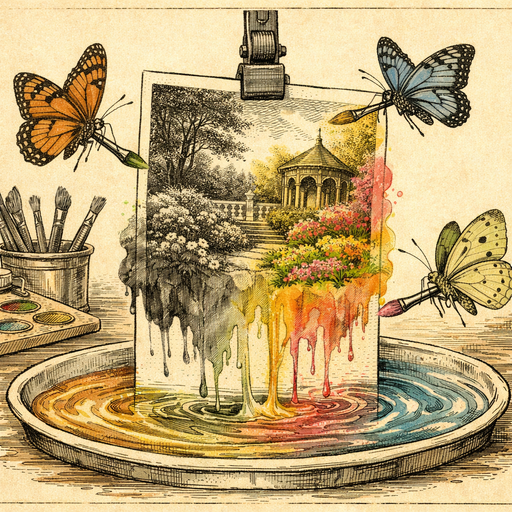
My cousin Janet called me at 3 AM last Tuesday, which could only mean three things: someone died, someone was born, or she'd discovered another family conspiracy. This time it was option three, and it involved a daguerreotype she'd found wrapped in tissue paper inside our great-great-grandmother's sewing box.
"I think Great-Great-Grandpa Samuel might not be Great-Great-Grandpa Samuel," she whispered into the phone like she was reporting state secrets. The photo showed a stern-looking man in what appeared to be Union Army uniform, standing next to a woman in a dark dress. Standard 1850s family portrait stuff, except for one tiny detail that Janet's magnifying glass had revealed: the woman was clearly pregnant, and according to our family Bible, Samuel and Mary's first child wasn't born until 1863.
When Black and White Hides the Truth
The problem with daguerreotypes and other antique photos is that they're like looking at history through a fog machine. Everything's silver-toned, shadowy, and vague. You can make out shapes and faces, but the subtle details that might reveal crucial information about clothing, skin tone, or even military insignia get lost in the monochromatic haze.
Janet had been staring at this photo for weeks, trying to decipher whether the uniform details matched Union Army standards, whether the woman's complexion suggested she might be from a different ethnic background than we'd always assumed, and whether those were wedding rings or just scratches on the old silver plate.
That's when I remembered the colorization tool I'd been experimenting with for some client work. AI colorization has gotten scary good at analyzing historical photos and making educated guesses about what colors should go where based on contextual clues. It's not magic, but it's pretty close.
Digital Time Travel
The next morning, Janet scanned the daguerreotype at ridiculously high resolution and sent it over. The original was barely 3 inches square and looked like it had been stored in a coal mine for 170 years. After uploading it to the colorization tool (which processes everything right in the browser, so our family secrets stayed secret), we watched the AI work its temporal magic.
What emerged was fascinating. The uniform wasn't Union Army blue at all, it was Confederate gray. The woman's dress, which had appeared black, was actually deep burgundy. Most importantly, her complexion suggested Native American heritage, which would explain why that branch of our family tree had always seemed mysteriously sparse on documentation.
Suddenly, our family's Civil War story made a lot more sense. Samuel hadn't been a Union hero who'd died gloriously in battle like we'd been told. He'd been a Confederate soldier who'd married a Cherokee woman in 1860, had a child in 1861, and probably deserted when the war got ugly. The family had spent 160 years covering up what they saw as shameful history.
The Color of Revelation
This is the weird power of colorization. It doesn't just make old photos pretty, it reveals information that was always there but invisible to the naked eye. Military historians use colorized photos to identify specific regiments based on uniform details. Genealogists use them to spot ethnic heritage clues that monochrome photos obscure. Even fashion historians rely on colorization to understand how people actually dressed in different eras.
The AI analyzing our daguerreotype had looked at thousands of similar photos from the 1860s, cross-referenced uniform styles, skin tones, and fabric patterns, then made educated guesses about what colors belonged where. It wasn't inventing history, it was revealing history that the limitations of 1860s photography had hidden.
Janet and I spent the next three hours going through every family photo we could find, colorizing the ones that looked promising. We discovered that Great-Aunt Martha's "mysterious illness" was probably just her red hair being considered scandalous in the 1920s (she'd been wearing it down instead of pinned up). We found evidence that Uncle George had served in WWI despite family claims he'd been a conscientious objector (his uniform details became visible once colorized). Every newly colored photo was like opening a time capsule.
The Technical Magic Behind Historical Detective Work
Modern AI colorization works by analyzing millions of historical photographs, learning patterns about how light interacts with different materials, skin tones, and fabric types in various time periods. When you upload a black and white photo, the algorithm examines contextual clues like clothing styles, architectural details, and even photographic techniques to make informed decisions about color placement.
The process happens entirely in your browser, which means your family photos never get uploaded to anyone's servers. This is particularly important when you're dealing with sensitive family history or potentially controversial discoveries. The last thing Janet needed was our Confederate ancestor showing up in some AI company's training dataset.
The tool also lets you adjust the colorization if the AI makes obvious mistakes. If it colors someone's hair blonde when you know from other sources they were brunette, you can guide it toward more accurate results. It's like having a conversation with a very smart, historically-informed artist who happens to work at the speed of light.
Conclusion
Three weeks later, Janet had rewritten our entire family tree based on what the colorized photos revealed. Samuel and Mary's real story turned out to be far more interesting than the sanitized version our ancestors had passed down. They'd been an interracial couple during one of the most turbulent periods in American history, which explained why so many family records had mysteriously disappeared.
Sometimes the most powerful technology isn't the flashiest. Adding color to old photos sounds simple, but it can unlock secrets that have been hiding in plain sight for generations. Whether you're solving family mysteries, researching local history, or just want to see what your great-grandparents actually looked like, AI colorization turns historical detective work into something anyone can do from their kitchen table.
Janet framed the colorized daguerreotype and put it on her mantle. For the first time in 170 years, Samuel and Mary are getting the recognition they deserved instead of the shame they were given. Not bad for a Tuesday night phone call and five minutes of browser-based AI magic.
Try it yourself
Free, private, runs in your browser. No sign-up required.