
 April 20, 2026
 4 min read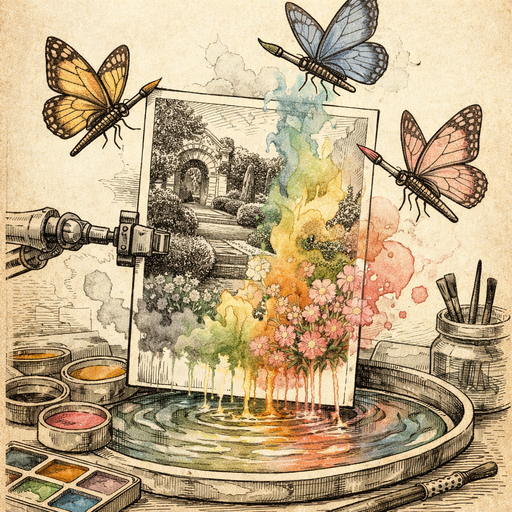
Sarah Martinez was three months into her archaeology graduate thesis when she stumbled upon a dusty box in the university's basement archive labeled "Mesopotamian Expedition 1923-1925." Inside were hundreds of black-and-white photographs from early excavations in Iraq, complete with detailed notes about pottery fragments, burial sites, and daily life at the dig. The problem? Her thesis committee wanted her to create a compelling presentation about how archaeological methods have evolved, but these century-old monochrome images felt as distant as the ancient civilizations they documented.
That's when Sarah discovered something remarkable: adding color to these historical photographs didn't just make them prettier, it made them tell stories. Suddenly, the red clay pottery wasn't just "ceramic fragments," it was dinnerware that someone had carefully painted with ochre pigments. The excavation site wasn't just "disturbed soil layers," it was a workspace where people had labored under a blazing desert sun, their clothing practical khaki against the dusty landscape.
The Challenge of Historical Context
Black-and-white photography dominated archaeological documentation for decades, not by choice but by necessity. Color film was expensive, unreliable in extreme temperatures, and required careful storage that field expeditions couldn't guarantee. The result? Thousands of archaeological photographs that capture important historical moments but lack the visual impact to engage modern audiences.
Sarah faced a common academic dilemma: how do you make historical research accessible without compromising its integrity? Her thesis advisor had been clear that any modifications to historical documents needed to be transparent and reversible. Traditional photo editing software felt too complex and expensive for a graduate student budget, plus she needed something that wouldn't upload these irreplaceable images to unknown servers.
Why Colorization Matters for Historical Research
Adding color to historical photographs isn't about making them "look better," it's about historical interpretation. When archaeologists look at excavation photos, they're trying to understand context: What was the lighting like? How did the soil composition affect preservation? What materials were the artifacts made from? Color provides crucial visual information that can inform research decisions decades later.
Modern AI colorization has become sophisticated enough to make educated guesses about historical accuracy. It understands that desert excavations typically feature earth tones, that metal artifacts develop specific patinas, and that human skin and clothing follow certain patterns based on historical context and geographic location.
The Technical Breakthrough
Sarah needed a solution that was both powerful and practical. Using the AI colorization tool, she could process her historical photographs without worrying about privacy concerns. Since the AI runs entirely in the browser, those irreplaceable archival images never left her computer, satisfying both her academic ethics requirements and the archive's strict policies about digital security.
The results were remarkable. A photograph of pottery shards revealed the subtle red and brown glazes that indicated specific firing techniques. Images of the excavation team showed the practical khaki and white clothing that was standard for desert work in the 1920s. Most importantly, the colorized site photographs helped Sarah identify geological features that had been invisible in the original black-and-white versions.
Academic Standards and Digital Ethics
Sarah's experience highlights an important consideration for anyone working with historical materials: transparency about modifications. She created a clear documentation system, keeping original images alongside colorized versions with detailed notes about the AI processing. This approach satisfied her academic requirements while creating a more engaging presentation for her thesis defense.
The colorization process also sparked interesting conversations with her advisor about the interpretation of historical evidence. Some colors in the AI results prompted research into period-appropriate materials and techniques, leading to new insights about the expedition's methodology.
Beyond the Classroom
Sarah's project caught the attention of the university's digital humanities department, who were impressed by how AI colorization could make historical archives more accessible to students and the public. Museums have started exploring similar techniques to create more engaging exhibits without altering their original collections.
The technique isn't limited to archaeological photographs. Family historians, local historical societies, and genealogy researchers are discovering that colorized images help bridge the gap between past and present. A black-and-white photograph of great-grandmother suddenly becomes a person you might recognize on the street.
The Broader Impact
What started as a graduate student's thesis problem has broader implications for how we interact with historical visual materials. Colorization doesn't replace careful historical research, but it can enhance understanding and engagement. When people see historical photographs in color, they often notice details that were invisible in monochrome: the texture of fabrics, the condition of buildings, the subtle environmental cues that provide context.
For researchers like Sarah, AI colorization offers a practical tool that respects both academic standards and budget constraints. The ability to process images locally addresses privacy concerns while producing results sophisticated enough to support serious academic work.
Conclusion
Sarah's archaeology thesis earned high marks, partly because her colorized historical photographs helped the committee visualize the evolution of excavation techniques over the past century. But the real success was discovering how modern AI tools could enhance historical research without compromising academic integrity. Whether you're a graduate student working with archival materials, a family historian exploring old photographs, or just curious about bringing your black-and-white images to life, AI colorization offers a bridge between past and present. The key is approaching it as a tool for exploration and understanding, not just aesthetic enhancement. Sometimes the most important discoveries happen when we see familiar things in a new light.

Try it yourself
Free, private, runs in your browser. No sign-up required.